
English 
+86-21-57450120
+86-18221926197
+86-18221926197
No.1418 Zhuangliang Road, Zhuanghang Town, Fengxian District, Shanghai 201415, P.R. China

Views: 0 Author: Site Editor Publish Time: 2026-01-02 Origin: Site


Neglecting maintenance on packaging lines is rarely a silent failure; it usually announces itself through expensive product giveaway, contamination recalls, or sudden, unplanned downtime. For manufacturers handling particulate products, the stakes are even higher. A calibration drift of just 1% on a high-speed line can result in thousands of dollars of lost product per month. Unlike liquid or granular systems, maintaining powder filling machines presents a unique set of challenges. Operators must contend with aggressive dust intrusion, the invisible force of static electricity, and extreme sensitivity to ambient humidity.
This guide moves beyond basic cleaning instructions to focus on asset lifecycle management and precision assurance. Whether you operate auger fillers, cup fillers, or net-weigh systems, the principles of environmental control, usage-based replacement, and rigorous calibration remain the same. By shifting from a reactive "fix-it-when-it-breaks" mentality to a proactive strategy, you protect both your machinery and your bottom line. The following sections detail five actionable maintenance strategies designed to maximize the efficiency and accuracy of your powder filling operations.
Environment is Critical: Humidity and static control are as important as mechanical repairs for powder consistency.
Drift = Loss: Weighing system calibration should be proactive, not reactive to complaints.
Hygiene Standards: Visual cleanliness is insufficient; validation (ATP) prevents cross-contamination.
Wear Part Strategy: Shift from "run-to-failure" to "usage-based" replacement for seals and augers.
Operator Empowerment: The most effective maintenance tool is a trained operator with a checklist.
Mechanical precision is useless if the environment fights against the product. In powder packaging, the atmosphere inside the production room is effectively a machine component. Variations in temperature and humidity do not just make operators uncomfortable; they physically alter the flow characteristics of the powder, leading to machine errors that look like mechanical failures but are actually environmental issues.
Powder behavior is fluid. When environmental conditions change, the friction between particles changes. Many powders, such as dairy products, protein powders, or chemical additives, are hygroscopic. They actively absorb moisture from the air. When relative humidity (RH) spikes, these powders become sticky. Inside the hopper, this manifests as "ratholing" or bridging.
Ratholing occurs when the powder adheres to the hopper walls, leaving only a narrow vertical tunnel directly above the tooling. The auger continues to spin, but it is not fully primed with product. This results in severe underfilling. Operators often mistakenly blame the tooling speed or the servo motor, leading to unnecessary mechanical tinkering, when the root cause is actually uncontrolled ambient moisture.
Static is the silent killer of accuracy and electronics. As powder moves through tubes, funnels, and augers, friction generates a static charge. If this charge is not dissipated, it creates two major risks:
Fill Weight Variation: Charged powder clings to the discharge nozzle or "dusts out" of the container. This results in messy seals and lightweight packages.
Electronic Damage: High-voltage static discharges can arc into the machine's PLC or HMI, causing inexplicable logic errors or permanent component failure.
To mitigate this, verify the grounding integrity of the entire frame. Utilizing anti-static mats and grounding straps is a baseline requirement. For high-speed lines, consider installing ionizing air nozzles at the discharge point of the automatic powder filling machine. These devices neutralize the charge in the air curtain surrounding the product, ensuring the powder falls straight into the container without clinging to the machine or the sealing surfaces.
Maintaining a stable climate is non-negotiable for consistent performance. Most free-flowing powders require a relative humidity range of 30–50%. If humidity drops too low, static electricity becomes unmanageable. If it rises too high, you risk "cementing."
Cementing happens when moisture causes powder to harden on the auger screw flights. This increases the friction coefficient, forcing the servo motor to apply more torque to spin the screw. Over time, this excessive load can overheat the motor or shear the drive shaft. Investing in industrial dehumidifiers and climate monitoring is often cheaper than replacing burnt-out servo motors.
A common maintenance error is waiting for a part to fail before replacing it. In high-precision filling, a part often fails to perform correctly long before it physically breaks. Moving to a usage-based replacement strategy ensures that quality remains high throughout the machine's life.
Certain components degrade based on the volume of product processed, not the time elapsed. Auger screws, funnels, hopper gaskets, and agitator blades are in constant contact with abrasive materials. Their lifespan should be measured in "cycles" or "tons filled," not months.
| Component | Failure Mode | Recommended Replacement Trigger |
|---|---|---|
| Auger Screw | Micro-abrasion reducing flight volume | Production Volume (e.g., every 500 tons) or Dimensional check |
| Hopper Gasket | Cracking, loss of elasticity | Cycle count / Changeover frequency |
| Agitator Blade | Thinning edges, bending | Visual inspection every 500 hours |
| High-Speed Seals | Leakage into bearings | Running hours (preventive) |
Many powders, such as sugar, salt, or silica, are abrasive. Over millions of cycles, the abrasive action acts like sandpaper on the stainless steel flights of the auger screw. This erosion is often microscopic and invisible to the naked eye, but it reduces the physical volume of the screw.
If an auger is designed to deliver 50 grams per revolution, a worn auger might only deliver 49.5 grams. The machine settings haven't changed, but the output has dropped. Operators typically react by increasing the revolution count to compensate. While this fixes the weight temporarily, it masks the mechanical degradation. Eventually, the gap between the screw and the funnel wall increases, allowing product to slip back (backflow), causing fill weight inconsistency. Regular dimensional checks of the tooling are the only way to catch this.
Seals in powder fillers serve a dual purpose: they keep the product in and contaminants out. A leaking hopper gasket allows fine dust to escape into the machine cabinet. This dust eventually finds its way into bearings and gearboxes.
When powder mixes with bearing grease, it creates a grinding paste that destroys the bearing from the inside out. Replace seals based on "bag counts" or "production hours." Do not wait for a visible dust cloud. If you see powder leaking, the damage to the internal mechanics has likely already begun.
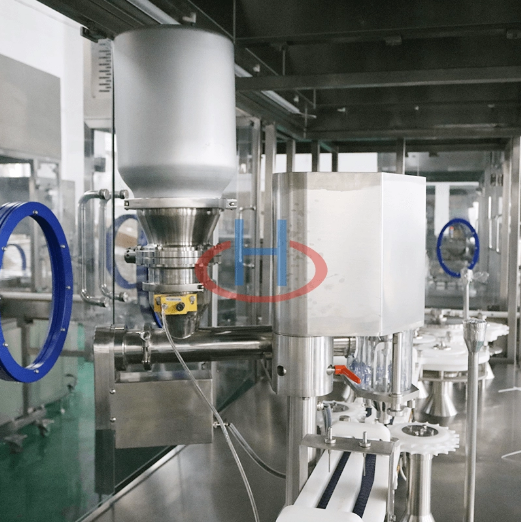
Accuracy is the primary value proposition of any filling equipment. However, load cells and checkweighers are not "set and forget" devices. They suffer from a phenomenon known as "drift."
Drift is the slow, often imperceptible loss of calibration accuracy. It is rarely caused by a sudden failure. Instead, it accumulates due to sensor fatigue, temperature fluctuations, debris buildup on the weigh bucket, or subtle vibrations from nearby machinery. A scale that drifts 0.5 grams over a shift might seem negligible, but across 10,000 units, that represents 5 kilograms of product giveaway.
Calibration must be a ritual, not an afterthought. Establish a strict schedule based on production intensity. For high-volume lines, calibration checks should occur at the start of every shift and after every product changeover.
The methodology matters. Operators should never use a "golden sample" (a pre-filled bag) for calibration. Product inside a bag can shift, absorb moisture, or degrade. Always use certified reference weights (test weights) to verify load cells. These weights provide an immutable standard that ensures the machine is reading true to reality.
If a scale refuses to hold zero or fluctuates wildly, check for mechanical interference before replacing the electronics. This is often called "mechanical shunting."
Look for debris wedged under the scale platform or hardened powder bridging the gap between the live load cell and the rigid frame. Additionally, inspect cable tension. A cable that is zip-tied too tightly to the machine frame can pull on the load cell, creating a false force reading. For an automatic powder filling machine, ensure that the vibration from the main filler head or the container indexing conveyor is not resonating into the scale platform. Isolating the weighing unit on independent rubber mounts can often solve mysterious accuracy issues.
In industries like food, pharmaceuticals, and nutraceuticals, "looking clean" is not the same as "being sanitary." Powder residues can hide in microscopic crevices, becoming breeding grounds for bacteria or sources of allergen cross-contamination.
Visual cleanliness removes visible debris. Sanitary cleaning removes the invisible chemical and biological hazards. Relying solely on visual checks is a liability, especially when switching between allergens (e.g., from peanut flour to wheat flour). A single speck of remaining powder can trigger a recall.
To ensure true sanitation, implement Adenosine Triphosphate (ATP) testing. ATP is an energy molecule found in all living cells, including bacteria and food residues. After cleaning, an operator swabs critical contact surfaces and inserts the swab into a handheld meter.
The meter provides a numerical reading (RLU) indicating the level of biological residue remaining. This validates that the cleaning process was effective. If the reading fails, the crew cleans again. This scientific validation protects the brand and proves due diligence in the event of a safety audit.
How you clean is just as important as when you clean. A common but dangerous practice is using high-pressure compressed air to blow dust off the machine. This is a critical mistake.
Do Not: Use air guns near open electrical cabinets or bearings. High-pressure air forces conductive dust deep into electrical contactors (risking short circuits) and pushes particles past bearing seals.
Do: Use explosion-proof vacuums and lint-free cloths. Dismantle the auger and funnel assembly for wet cleaning in a dedicated wash-down area, rather than cleaning them in place where water can ingress into the motor housing.
Lubrication requires strict discipline in a powder environment. Excess grease is a magnet for dust. When grease captures powder, it becomes a thick, abrasive sludge that clogs moving parts rather than lubricating them.
Always use NSF H1 food-grade lubricants for any component located above the product line. This ensures that if incidental contact occurs, the product remains safe for consumption. Apply lubricant sparingly and wipe away any excess immediately to prevent dust accumulation.
The best maintenance strategy combines hardware availability with human capability. Machines do not fix themselves, and waiting three weeks for a heater band is a preventable loss.
Autonomous maintenance shifts the responsibility for basic daily tasks from the maintenance department to the machine operators. Operators know the machine best—they hear the subtle changes in sound and feel the vibrations.
Empower them to handle cleaning, daily lubrication, and basic visual inspections. This creates a sense of ownership. When operators are responsible for the machine's health, they stop treating it like a "black box" and start treating it like a tool. This frees up skilled technicians to focus on complex repairs and root-cause analysis rather than changing filters or tightening bolts.
Not all spare parts are created equal. Inventory should be stratified based on criticality and lead time. A "stock-out" on a Tier A part means total production stoppage.
| Tier | Definition | Examples |
|---|---|---|
| Tier A (Critical) | Machine cannot run without it; high failure rate or consumable. Must be on-site. | Heating elements, Teflon tapes, hopper gaskets, load cells, fuses. |
| Tier B (Planned) | Long lead time; predictable wear. Order based on condition monitoring. | Auger screws, belts, bearings, PLC input cards. |
| Tier C (Low Risk) | Rarely fails; standard hardware available locally. | Bolts, structural brackets, guarding panels. |
While operator involvement is good, "tinkering" is bad. Training must clearly define "No-Touch" zones. Operators should never adjust variable frequency drive (VFD) parameters, physically move load cell stops, or bypass safety interlocks to speed up production.
Lock out deep-level HMI menus with passwords. Mark physical adjustment points (like conveyor guide rails) with color-coded indicators to show the correct positions. This prevents "adjustment creep," where settings are gradually changed shift after shift until the machine no longer runs efficiently.
Effective maintenance of powder filling machines is a blend of strict environmental control, disciplined calibration routines, and strategic inventory management. It requires looking beyond the mechanical movements to understand how humidity, static, and wear affect the microscopic behavior of the powder itself. By validating cleaning with ATP, replacing parts based on usage data, and empowering operators with clear checklists, manufacturers can significantly reduce Total Cost of Ownership (TCO).
Investing in these five areas yields a high ROI by minimizing product giveaway and extending the usable life of the asset. Audit your current maintenance logs against these points today. If you find gaps in your calibration schedule or humidity control, close them before they result in a costly downtime event.
A: Calibration frequency depends on production volume and industry regulations. As a best practice, calibrate at the start of every shift and immediately after any product changeover. For high-value pharmaceutical or nutraceutical powders, more frequent checks (e.g., every 4 hours) may be required to comply with GMP standards and minimize expensive product giveaway due to drift.
A: Weight variation is typically caused by three factors: inconsistent powder density (often due to humidity changes), fluctuating head pressure in the hopper (product level too low or too high), or worn tooling (auger screws). Static electricity clinging to the nozzle can also cause random discharge issues.
A: No. You must use NSF H1 food-grade lubricants for any area where there is even a remote possibility of incidental contact with the product. Standard grease poses a chemical contamination risk. Additionally, ensure you do not over-lubricate, as excess grease attracts dust and creates an abrasive paste that wears out parts faster.
A: Bridging is usually solved by optimizing agitation settings and controlling the environment. Ensure the agitator blade speed and design match the powder's flow characteristics. Crucially, maintain relative humidity between 30–50% to prevent clumping. If the powder is naturally cohesive, FDA-approved flow aid additives (like silicon dioxide) or external hopper vibrators may be necessary.


