
English 
+86-21-57450120
+86-18221926197
+86-18221926197
No.1418 Zhuangliang Road, Zhuanghang Town, Fengxian District, Shanghai 201415, P.R. China

Views: 0 Author: Site Editor Publish Time: 2026-03-30 Origin: Site


Selecting the right filling equipment is a pivotal decision for any oral liquid manufacturer. For small-volume products like 50ml doses, precision is not just a feature; it is the cornerstone of quality and profitability. The filling machine is the heart of your production line. Its performance directly impacts product stability, shelf life, regulatory compliance, and ultimately, your bottom line. In today's competitive pharmaceutical and nutraceutical markets, savvy producers are moving beyond simple "nominal capacity" figures. They now focus on "effective throughput"—the real-world output that accounts for changeovers, cleaning, and accuracy. This guide will walk you through the critical factors for choosing equipment that delivers both precision and a strong return on investment, ensuring your production line is efficient and compliant from day one.
Viscosity is the Primary Filter: Your liquid’s flow characteristics dictate whether you need a piston, peristaltic, or gravity-based system.
Precision Equals Profit: In 50ml doses, a 1% error leads to significant "product giveaway" or regulatory non-compliance.
Automation ROI: Transitioning to an 8-head linear liquid filling machine is the tipping point for scaling from pilot to commercial volumes.
Sanitary Design is Non-Negotiable: For oral liquids, 316L stainless steel and CIP (Clean-in-Place) capabilities are essential for GMP compliance.
Before you evaluate any machinery, you must deeply understand the physical properties of your liquid product. The product itself is the most important variable in the selection process. Its behavior under pressure, in motion, and over time will determine the appropriate filling technology. Ignoring these characteristics leads to inaccurate fills, production bottlenecks, and potential product degradation.
Viscosity, or a liquid's resistance to flow, is the first filter for your equipment choice. A low-viscosity, water-like liquid behaves very differently from a thick, viscous syrup or oil-based supplement.
Low-Viscosity Liquids: Products like herbal tinctures or simple solutions flow easily. They are suitable for gravity or overflow fillers, which rely on the product's own weight or a consistent level-fill principle. However, these systems require drip-proof nozzles to prevent splashing and ensure clean fills.
High-Viscosity Liquids: Syrups, gels, and some nutritional oils require positive displacement pumps, such as piston fillers. These machines use a precise mechanical force to move a specific volume of product, overcoming its resistance to flow.
Furthermore, you must consider if your product contains "shear-sensitive" ingredients. Certain proteins, emulsions, or biological actives can be damaged or broken down by the high-pressure action of some pumps. For these delicate products, low-shear pumps like peristaltic or lobe pumps are a much better choice. They move the liquid gently, preserving its integrity.
Many oral liquids, especially those containing proteins or surfactants, have a tendency to foam when agitated. Aeration during the filling process is a major problem. It introduces oxygen, which can degrade the product, and it causes inaccurate volumetric fills because you are filling with a mix of liquid and air. To combat this, look for machines with specific anti-foaming features:
Sub-surface Filling: The filling nozzle descends into the bottom of the 50ml container and retracts as the liquid level rises. This technique minimizes turbulence and aeration.
Variable Fill Speeds: A good machine can be programmed to start filling slowly, then speed up, and slow down again at the end. This "bottom-up slow-fast-slow" profile is highly effective at preventing foam.
Drip-Proof Nozzles and "Snift" Valves: After the fill, a small amount of product can cling to the nozzle tip and drip onto the container's neck, creating a mess and a potential sealing issue. Drip-proof nozzles use a mechanical shut-off, while some advanced systems incorporate a "snift" valve that pulls a tiny vacuum to suck the last drop back into the nozzle.
If your oral liquid is a suspension containing active solid ingredients (e.g., minerals, herbal powders), maintaining homogeneity is critical. You must ensure that every 50ml dose contains the exact same concentration of active particulates. If the solids settle in the machine's hopper, the first bottles will be under-dosed and the last ones over-dosed.
The solution is an agitated hopper. A gentle, slow-moving paddle or mixing blade continuously stirs the product in the holding tank. This keeps the particulates evenly suspended right up to the point of filling. The design of the agitator is important; it must be effective without introducing air or creating shear that could damage the ingredients.
Once you understand your product's physics, you can select the core filling technology. For precise 50ml doses common in pharmaceuticals and nutraceuticals, volumetric fillers are the industry standard. They dispense a pre-set volume of liquid. Gravimetric systems, which fill by weight, are less common for this scale but offer the highest accuracy for extremely valuable products.
Piston filling technology remains the gold standard for accuracy and versatility with a wide range of viscosities. A piston filler operates like a large syringe. A piston retracts within a cylinder, drawing in a precise volume of product. It then extends, dispensing that exact volume into the container. This method is highly repeatable and accurate, often achieving fill tolerances of +/- 0.5% or better.
You can choose between two main types:
Mechanical (Cam-Driven) Pistons: These are robust, reliable, and cost-effective. They are excellent for dedicated lines running a single product and container size.
Servo-Driven Pistons: These offer superior control and flexibility. An electronic servo motor drives the piston, allowing for precise, programmable control over the fill speed and volume. This enables sophisticated fill profiles to manage foaming and allows for tool-less volume changes via a Human-Machine Interface (HMI), making them ideal for facilities with multiple products.
Peristaltic pumps offer a unique advantage for sterile or high-purity applications. In this system, the liquid only ever touches the inside of a single piece of medical-grade tubing. A set of rollers on a rotor compresses the tube, creating a gentle pumping action that moves the fluid forward. This design has several key benefits:
No Cross-Contamination: The product path is disposable. You can change the tubing between batches in minutes, completely eliminating the risk of one product contaminating another.
Gentle Handling: The pumping action is very low-shear, making it perfect for sensitive biologicals or cell cultures.
Easy Cleanup: Since the product never touches the machine's mechanical parts, cleaning is incredibly fast and simple.
This technology is ideal for expensive Active Pharmaceutical Ingredients (APIs), gene therapies, or small-batch R&D work where product loss and contamination are primary concerns.
For businesses looking to scale up from manual or semi-automatic processes, the 8-head linear liquid filling machine often represents the perfect balance of performance, footprint, and cost. A linear filler indexes bottles in a straight line under a series of filling nozzles.
Why is 8 heads often the "sweet spot" for 50ml containers?
Throughput: It provides a significant increase in output over 2- or 4-head models, allowing you to meet commercial demand without the massive footprint and cost of a large rotary filler.
Flexibility: Linear fillers are generally easier and faster to change over than rotary machines. Adjusting for different 50ml bottle heights or diameters is straightforward, making them well-suited for contract manufacturers or brands with diverse product portfolios.
Footprint: They offer a compact, rectangular footprint that fits well into many existing production floor layouts.
While rotary fillers offer higher top-end speeds, their complexity and changeover time often make a flexible linear system a more practical and cost-effective choice for small-format bottles in mid-scale production.
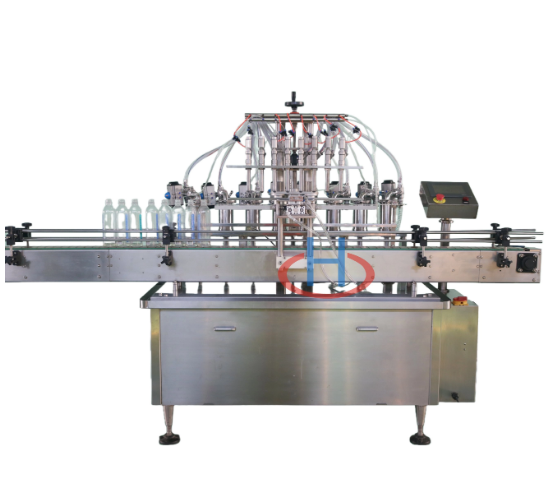
A filling machine does not operate in isolation. It is a key component of a complete oral liquid filling production line. To achieve true efficiency, the filler must be perfectly synchronized with both upstream (bottle handling) and downstream (capping, labeling) equipment. A mismatch in speed or capability at any point will create a bottleneck that cripples the entire line's output.
Before the bottles reach the filler, they must be prepared. For pharmaceutical-grade operations, this typically involves:
Bottle Unscrambling: An automated system that takes bulk bottles and orients them upright onto the conveyor.
Air-Rinsing or Washing: A station that uses ionized, filtered air or sterile water to remove any dust or particulates from inside the containers.
After filling, the process must continue seamlessly:
Capping/Plugging: The capper must keep pace with the filler. A slow capper will cause bottles to back up and halt the filling process.
Induction Sealing: For tamper evidence, an induction sealer bonds a foil liner to the bottle's rim.
Labeling and Coding: Finally, the labeler applies the product label, and a coder prints the lot number and expiration date.
The speed of every single machine must be matched to the target output to avoid stop-and-go production, which reduces efficiency and can compromise product quality.
In a modern production environment, especially for contract packagers, a machine might fill several different products or bottle sizes in a single day. The time it takes to switch from one job to the next ("changeover time") is non-productive downtime. Minimizing it is key to profitability.
Look for equipment designed for rapid changeovers:
Tool-less Adjustments: Guide rails, nozzle heights, and other key components should be adjustable using handwheels and locking levers, not wrenches and screwdrivers.
Recipe-Driven PLC Systems: High-end machines allow you to save all the parameters for a specific product/bottle combination as a "recipe" in the PLC (Programmable Logic Controller). To change over, the operator simply selects the next recipe from the HMI screen, and the machine automatically adjusts fill volumes, speeds, and timings.
The materials your machine is made from matter. For oral liquids, all product contact parts must be made from 316L stainless steel, a high-grade, corrosion-resistant alloy. For highly acidic or corrosive liquids, special polymers like HDPE or PEEK may be required for certain components to ensure longevity.
A modern challenge is the trend toward "lightweighting" PET bottles to reduce plastic usage and cost. These "feather-weight" bottles are very thin and can be easily crushed or deformed by overly aggressive bottle handling mechanisms or improperly set up guide rails. The chosen 50ml oral liquid filling equipment must be gentle enough to handle these delicate containers without damage.
For any product intended for human consumption, regulatory compliance and sanitary design are non-negotiable. Your equipment must be designed and built to meet the stringent standards of bodies like the FDA (U.S. Food and Drug Administration) and EMA (European Medicines Agency) and adhere to Good Manufacturing Practices (GMP).
GMP guidelines dictate nearly every aspect of pharmaceutical equipment design. Key requirements include:
Material Traceability: The supplier must provide certificates for all product contact materials, like 316L stainless steel.
Sanitary Welds and Finishes: All welds must be smooth, and surfaces should be polished to a high degree. A surface finish with a roughness average (Ra) of less than 0.4 micrometers is often required to prevent microscopic pockets where bacteria can hide and grow.
No Crevices or Dead Legs: The design must eliminate any sharp corners, threads, or "dead leg" pipes where product can get trapped and become difficult to clean.
Manual cleaning is time-consuming and introduces a risk of human error. Modern filling lines are designed for automated cleaning. - Clean-in-Place (CIP): The machine is connected to a CIP skid that circulates cleaning solutions (e.g., caustic, acid, sanitized water) through the entire product path without disassembly. This reduces downtime dramatically. - Steam-in-Place (SIP): For sterile applications, the system is designed to be sterilized using high-temperature steam after cleaning.
When purchasing a machine, you must ensure it is CIP/SIP-ready. This means it has the correct sanitary fittings, sloped piping for drainage, and components that can withstand the high temperatures and harsh chemicals used in these cycles. The ability to validate cleaning protocols—proving with scientific data that zero residue remains—is essential for regulatory compliance.
Modern pharmaceutical manufacturing requires robust data collection and security. 21 CFR Part 11 is an FDA regulation that governs electronic records and signatures. If your filling line records production data electronically (e.g., batch records, fill weights, alarms), the system must be compliant. This involves features like secure user logins, audit trails that track every change, and un-editable records.
This push for data is part of the Industry 4.0 trend. Modern fillers can be equipped with sensors that provide real-time monitoring of critical parameters. For example, checkweighers can be integrated to provide feedback to the filler, automatically adjusting fill volumes if they begin to drift. This allows for proactive quality control and reduces reject rates.
A smart equipment purchase focuses on the Total Cost of Ownership (TCO), not just the upfront price tag. TCO considers all costs over the machine's entire lifecycle, including product loss, maintenance, downtime, and operational efficiency. A cheaper machine can often be far more expensive in the long run.
Filling accuracy is directly tied to your profitability. Every drop you overfill is "product giveaway"—finished product you are giving to customers for free. Over a year, this adds up to a significant financial loss. Conversely, underfilling can lead to consumer complaints and hefty regulatory fines.
Consider this simple scenario for a 50ml product:
| Metric | Machine A (±1.5% Accuracy) | Machine B (±0.5% Accuracy) |
|---|---|---|
| Target Fill Volume | 50.0 ml | 50.0 ml |
| Average Overfill (to be safe) | 0.75 ml | 0.25 ml |
| Product Cost per Liter | $50.00 | $50.00 |
| Bottles Filled per Year | 2,000,000 | 2,000,000 |
| Annual Cost of Giveaway | $75,000 | $25,000 |
| Annual Savings with Machine B | $50,000 |
In this example, the more accurate Machine B pays for its potentially higher purchase price very quickly, simply by saving product.
Every machine has parts that wear out over time, such as seals, gaskets, O-rings, and tubing. The cost and availability of these parts are a key component of TCO. Ask potential suppliers:
What is the predicted lifespan of common wear parts?
How much does a standard spare parts kit cost?
Do you have local technical support and parts warehousing? Waiting weeks for a critical part from overseas can be a disaster.
The nature of your product also affects maintenance. Abrasive suspensions will wear out seals and valves faster than a simple water-like solution.
Your business will hopefully grow. Will your filling machine grow with you? Look for modular designs. Some linear fillers are designed so you can start with 4 or 6 filling heads and add more later to increase your throughput as demand increases. This allows you to manage your initial capital investment while planning for future expansion.
Also, consider the longevity of the control system. Is it based on a widely supported PLC platform like Allen-Bradley or Siemens? Using common, industry-standard components ensures that you will be able to get support and parts for the electronics for many years to come.
Choosing the right 50ml oral liquid filling equipment is a strategic decision that requires a holistic approach. By following a clear logic, you can de-risk the investment and select a machine that serves as a foundation for growth and quality.
Product First: Begin by thoroughly analyzing your liquid's physical properties. Viscosity, foaming, and particulate content will dictate the core technology you need.
Precision Second: Calculate the long-term financial impact of fill accuracy. A small improvement in precision can translate into massive savings in "product giveaway," justifying a higher initial investment.
Automation Third: Evaluate your throughput needs and changeover frequency to determine the right level of automation, such as moving to an 8-head linear system with recipe management.
Before you sign any purchase order, insist on a "Fill Test." Send your actual liquid product and a case of your final bottles to the equipment manufacturer and have them run a test. This is the only way to verify that the machine will perform as promised in your real-world conditions. Ultimately, the right equipment is more than just a piece of steel; it's a critical investment in your brand's reputation, operational stability, and long-term profitability.
A: The speed, measured in bottles per minute (BPM), depends heavily on the liquid's viscosity, foaming characteristics, and the bottle's neck opening. For a typical low-viscosity, non-foaming liquid, an 8-head machine can often achieve speeds of 80 to 120 BPM. For thicker or foamy products that require slower, more controlled fills, the speed might be closer to 50-70 BPM.
A: Yes, versatile machines like servo-driven piston fillers are excellent for this. They have the power to push thick syrups and the precision to control thin liquids. However, you will likely need different sets of nozzles—smaller ones for thin liquids to prevent dripping and wider ones for thick products to improve flow. The key is a machine with easily changeable parts and programmable fill profiles.
A: This is dictated by GMP standards and your specific product. A deep clean and sanitation are required between every product changeover to prevent cross-contamination. If you run the same product continuously, the cleaning schedule is determined by your internal validation protocols, but a full clean is typically performed at the end of a batch run or, at a minimum, at the end of each production week.
A: Accuracy refers to how close the average fill volume is to the target volume (e.g., 50ml). Repeatability (or precision) refers to how consistent the fills are with each other, regardless of the target. You can have a machine that is very repeatable (every fill is 51ml) but not accurate. The goal is to have a machine that is both highly accurate and highly repeatable.
A: For most mid-scale production, a linear filler is often better. It offers greater flexibility for changeovers, has a smaller footprint, and is generally less expensive. A rotary filler is a better choice only for extremely high-speed, dedicated lines running millions of identical vials, where its superior top-end speed can be fully utilized and justifies its higher cost and complexity.


