
English 
+86-21-57450120
+86-18221926197
+86-18221926197
No.1418 Zhuangliang Road, Zhuanghang Town, Fengxian District, Shanghai 201415, P.R. China

Views: 0 Author: Site Editor Publish Time: 2026-01-09 Origin: Site


Selecting the right equipment for your production line is rarely a simple calculation of maximum speed. Choosing between automatic and semi-automatic liquid filling machines represents a critical balance between capital expenditure (CapEx), operational agility, and long-term labor costs. A wrong decision here can bleed profit margins through excessive downtime or inflated payrolls.
A common misconception in the packaging industry is that "fully automatic is always better." This is not true. For businesses managing high SKU counts with short production runs, automation often creates bottlenecks rather than solving them. The time spent calibrating a high-speed line for a new bottle shape can sometimes exceed the time it takes to fill the order manually.
This article provides a transparent evaluation of throughput realities and hidden maintenance costs. We will explore the specific production triggers that dictate which machine fits your current business stage, ensuring your investment drives ROI rather than frustration.
Throughput Thresholds: Semi-automatic units typically cap at 800 bottles/hour (BPH), while automatic lines start at 1,000+ BPH.
The "Hidden" Cost of Automation: Automatic machines require longer changeover times (setup/calibration), making them less efficient for brands with 10+ SKUs running small batches.
Labor Shift: Automation doesn’t just remove labor; it shifts the requirement from "operators" to "skilled technicians" for maintenance and calibration.
Accuracy = Profit: Automatic fillers reduce product "giveaway" (overfilling) via PLC controls, which can justify the higher price tag for expensive liquids (CBD, perfumes, essential oils).
The primary difference between these machine types lies in the role of the human operator. Understanding this shift is essential for planning your workforce and daily floor operations.
In a semi-automatic setup, the machine relies entirely on human interaction to cycle. The workflow follows a strict "hands-on" rhythm. The operator manually places a container under the nozzle, engages a foot switch or sensor to trigger the fill, and removes the finished container.
Because the human is the pacer, output consistency becomes a variable. Throughput is tethered directly to operator fatigue, dexterity, and focus. If an operator is distracted, production slows immediately. However, this context is ideal for high-mix, low-volume environments. The operator provides 100% visual inspection for every bottle, adding value through quality control that automated sensors might miss on a budget line.
Switching to automatic liquid filling machines redefines the production floor. The cycle is governed by systems, not hands. Integrated conveyoring moves bottles, indexing gates or star wheels align them, and synchronized filling heads execute the dispense cycle.
Here, the operator’s role shifts from manual labor to line supervision. They are no longer lifting bottles. Instead, they monitor bulk supplies of liquid and caps, watch for jams at the inlet, and ensure downstream equipment is running smoothly. The consistency guarantee is significant; throughput is dictated by the PLC recipe, not human speed. The machine sets the pace, and the staff supports the machine.
When evaluating ROI, you must weigh raw speed against the agility required to switch products. The following comparison highlights where each technology excels.
| Feature | Semi-Automatic | Automatic |
|---|---|---|
| Throughput (CPM) | 5–15 Containers Per Minute | 20–100+ Containers Per Minute |
| Changeover Time | Rapid (Minutes) | Slow (30+ Minutes) |
| Skill Requirement | General Labor | Technical Operator |
| Best For | High SKU Diversity / Short Runs | Single Product / Long Runs |
Semi-automatic units generally deliver real-world estimates of 5 to 15 containers per minute (CPM). This variance depends heavily on fill volume and liquid viscosity. A thick cream takes longer to pump than water, regardless of how fast the operator works.
Automatic lines offer scalable ranges. Depending on the number of nozzles—ranging from two to sixteen heads—speeds can easily exceed 100 CPM. This scalability allows manufacturers to match machine output to consumer demand spikes.
This is where many buyers make costly errors. Semi-automatic machines hold a distinct advantage in agility. They usually require tool-less changeovers that take minutes. This is ideal for co-packers or private labelers who switch products five times a day.
Conversely, automatic machines suffer from a "changeover disadvantage." Switching bottle sizes requires guide rail adjustments, nozzle realignment, and PLC recipe selection. If you have 20 different bottle shapes that each run for only one hour, an automatic line will spend more time down for setup than it spends filling bottles.
"Giveaway" is the industry term for overfilling. To ensure you meet the legal volume stated on the label, you likely overfill slightly. On a semi-automatic line, human variation leads to higher giveaway to play it safe.
Automatic fillers utilize servo-driven precision and PLC controls to minimize this gap. For expensive commodities like CBD oil, perfumes, or essential oils, reducing giveaway by just 1% can save enough money to pay for the machine difference in less than a year. Accuracy is a direct profit driver.
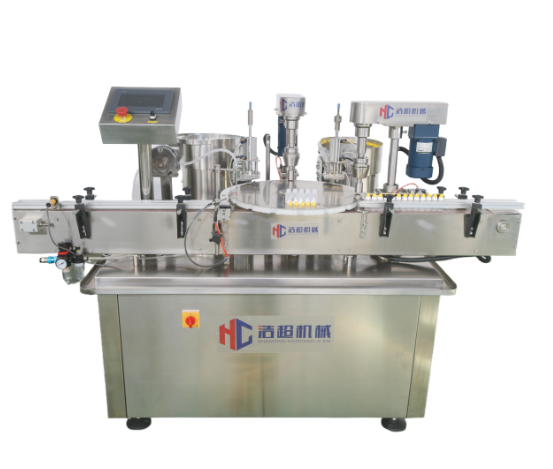
The sticker price is only the first component of cost. You must analyze the Total Cost of Ownership (TCO) over the machine's lifespan.
Semi-automatic units offer a lower entry barrier. They are affordable and require minimal installation. Fully automated lines represent a higher initial capital expenditure (CapEx). However, they lower operational expenditure (OpEx) over time by reducing the cost per unit produced—provided the volume is high enough to absorb the fixed costs.
Maintenance requirements differ vastly. Semi-automatic machines have a low technical barrier. They are mechanically simple, making them easy to troubleshoot with basic tools. Most general maintenance staff can fix a seal or swap a hose.
Automatic systems create a skills gap. They utilize PLCs, fiber optic sensors, and complex pneumatics. This requires higher technical literacy. You face a hidden cost: the need to train existing staff or hire a skilled line technician. Without this expertise on-site, a simple sensor error can cause extended downtime while you wait for external support.
Automation rarely exists in a vacuum. To function efficiently, automatic machines require peripheral equipment. You will likely need bottle scramblers to feed the line, accumulating tables to gather finished product, and downstream integration for capping and labeling. These integration costs must be factored into your budget, whereas a semi-automatic filler often stands alone on a table.
Your business stage usually dictates the correct equipment choice. Review these three scenarios to see where your operations align.
If your production is under 5,000 units per week, you likely fit here. You may deal with frequently changing bottle shapes and have limited floor space. For this stage, liquid filling machines that are semi-automatic are the logical choice. The business logic is clear: cash flow preservation takes priority over raw speed. You need market validation for new SKUs before committing to heavy tooling investments.
This scenario applies when single SKU runs last four hours or more. You likely hold long-term contracts with retailers requiring strict Service Level Agreements (SLAs). In this stage, the high cost of liquid bulk means precision savings outweigh the machine cost. The business logic shifts toward labor savings and yield consistency as primary ROI drivers.
There is a middle ground. Some manufacturers offer "upgradeable" designs. You can purchase semi-automatic benchtop fillers today that are designed to mount onto a conveyor system later. This allows you to convert your initial investment into a station on an automatic line, future-proofing your capital spend.
How do you know when you have outgrown your current setup? Look for these five critical indicators.
Demand Exceeds Human Capacity: Even with multiple semi-auto stations running simultaneously, you cannot meet order deadlines without paying excessive overtime.
Quality Control Issues: Inconsistent fill levels or messy bottles are damaging your brand reputation. If drips and spills are causing regulatory fines or customer complaints, automation offers the necessary precision.
Labor Volatility: You are experiencing high turnover in operator roles. If production stops every time an employee calls in sick, automation provides stability.
Single-Product Dominance: One specific SKU has grown to dominate 60% to 70% of your production schedule. This volume justifies a dedicated automatic line, freeing up your semi-auto machines for smaller, experimental batches.
Physical Space Constraints: Ironically, scaling up manual production takes more space. Multiple semi-auto stations, operators, and staging areas may consume more effective floor space than a streamlined, linear automatic conveyor system.
The "best" machine is not necessarily the fastest one. It is the machine that matches your current production mix, SKU diversity, and labor availability. For boutique producers, the agility of a semi-automatic unit preserves cash flow and flexibility. For growth-stage manufacturers, the consistency of an automatic line safeguards margins and ensures compliance.
Before soliciting quotes, conduct a time-study of your current production. Measure your actual changeover times versus your run times. If you spend more time setting up than filling, stay semi-automatic. If your runs are long and consistent, it is time to automate.
We encourage you to consult with an engineer to calculate the TCO for your specific liquid viscosity and bottle geometry. Making a data-driven decision now will secure your production efficiency for years to come.
A: Yes, but it depends on the model. Some modular benchtop fillers are designed to slide onto a conveyor track and integrate with a PLC later. However, many basic semi-auto units are standalone and cannot be converted. Always check for "slide-track" compatibility or modular control boxes if you anticipate growth.
A: Generally, you can expect a 3x to 5x increase in speed. While a semi-auto might hit 10 CPM, a standard automatic line hits 40–60 CPM. However, this multiplier only applies during run time. If you have frequent setups, the setup time on an automatic machine can negate this speed advantage.
A: Most likely. While semi-auto units often run on standard 110V/220V and small compressors, automatic lines typically require higher voltage (three-phase power) and significant Clean Dry Air (CDA) volume to run pneumatic gates and diving nozzles. Assess your facility's utility capacity before purchasing.
A: The automation level matters less than the filling principle (piston vs. gravity). However, automatic machines handle foaming liquids better because they use diving nozzles. These nozzles descend into the bottle and rise as the liquid fills, preventing agitation and foam, which is difficult to replicate consistently by hand.


