
English 
+86-21-57450120
+86-18221926197
+86-18221926197
No.1418 Zhuangliang Road, Zhuanghang Town, Fengxian District, Shanghai 201415, P.R. China

Views: 0 Author: Site Editor Publish Time: 2025-10-21 Origin: Site


Liquid filling machine are the backbone of many production lines, from beverages to pharmaceuticals. At Shanghai Haochao Machinery & Equipment Co., Ltd., we design systems that meet accuracy, sanitation, and speed requirements while minimizing waste. This guide explains the operating principles, compares common filling methods, and helps you choose the right machine for your product and production needs.
A liquid filling machine precisely dispenses a specified volume or weight of liquid into containers. Its production goals are consistent accuracy, reliable speed, and minimal product waste. Modern systems combine smart controls, sanitary design, and anti-drip hardware so manufacturers can meet regulatory and commercial targets.
Filling technology falls into several distinct principles. Each method is optimized for different fluid properties, container types, and production priorities.
How it works
Gravity filling relies on liquid head pressure. A product tank sits above the filling nozzles; valves open and the liquid flows down into the container until the level reaches the nozzle or a preset time elapses. This method is straightforward and cost-effective.
When to choose
Choose gravity filling for low-viscosity, low-foaming liquids like water, juices without pulp, thin detergents, and light chemical solvents.
Pros and cons
Pros: low cost, minimal shear on product, easy to clean.
Cons: less accurate at high speeds, not suitable for viscous or particulate-laden liquids, more prone to foaming when filling the surface.
Mechanics and accuracy
Volumetric (piston) filling measures and dispenses a fixed volume using a piston or cylinder. The piston retracts to draw liquid into the chamber and then pushes it out into the container. Volumetric systems produce repeatable fills with excellent accuracy and do not rely on container neck geometry for accuracy.
Why volumetric is good for viscous or measured-volume products
Viscous syrups, creams, and high-value liquids that require tight tolerances benefit from piston filling. Because the volume is mechanically determined, changes in liquid viscosity or container size have a smaller impact on the poured volume.
Tradeoffs
Piston systems are more complex and need occasional calibration and maintenance. They excel where precision outweighs the lowest possible equipment cost.
How pumps control flow
Gear, lobe, diaphragm, and peristaltic pumps meter and move product from tank to nozzle. Peristaltic pumps push liquid through flexible tubing via rollers, isolating fluid from machine internals. Other pump types push product directly.
Advantages for particulates, viscous liquids, and sterile lines
Pumps handle particulate-laden liquids and high viscosity with less pulsation or foaming. Peristaltic pumps are ideal for sterile or corrosive products because the liquid contacts only tubing which can be replaced or sterilized. Pump-based systems are flexible in line routing and often easier to combine with CIP procedures.
Vacuum-level filling
Used when accurate liquid level is required in rigid containers like glass bottles. A vacuum draws air out as the liquid fills, achieving consistent fill levels without turbulence.
Isobaric filling for carbonated beverages
Isobaric systems maintain pressure equilibrium between the bottle and product tank to prevent CO₂ loss and foaming. The fill happens under controlled pressure so carbonation is preserved and foaming minimized.
Overflow/level systems
Overflow filling ensures each container has the same liquid height, useful for clear bottles where appearance matters more than exact volume.
Fill heads / nozzles: The contact point for the liquid. Modern nozzles offer anti-drip geometry and bottom-up filling options.
Product tank (hopper): Holds the liquid supply; may be jacketed for temperature control.
Pumps and valves: Meter and direct flow. High-precision applications use servo-driven pumps.
CIP/SIP ports: Dedicated connections for Clean-in-Place and Steam-in-Place to sanitize product-contact surfaces without disassembly.
Control panel / HMI: Touchscreen interface for recipe management, diagnostics, and production monitoring.
Frame and materials: Food and pharma lines use FDA-approved stainless steel and sanitary seals to resist contamination.
Conveyor and indexing: Integrates the filling module into automatic lines.
Short note on materials
Product-contact surfaces should be polished stainless steel and FDA-grade elastomers. Proper material selection prevents leaching and makes sanitization effective.
Modern fillers combine hardware and software to hit production targets.
PLC and HMI: Programmable logic controllers run the sequence; HMI stores recipes for different containers and products.
Recipe memory: Operators switch between pre-saved parameters (volume, speed, dwell times) to reduce changeover time.
Servo-driven pumps and actuators: Provide smooth, programmable motion for accurate metering and repeatability.
Flow control and feedback: Flow meters, pressure sensors, and level probes provide closed-loop control for consistency.
Tradeoffs: Higher speed increases turbulence, foaming, and risk of drips. Machines mitigate this with controlled nozzle travel, bottom-up filling, and anti-drip valves.
CIP (Clean-in-Place)
CIP systems circulate cleaning fluids through product-contact surfaces without disassembly. This reduces downtime and contamination risk. CIP is essential in food, beverage, and pharmaceutical lines where frequent cleaning is mandated.
SIP (Steam-in-Place)
SIP uses steam to sterilize product contact surfaces and is common in pharmaceutical and sterile food production.
Why materials matter
FDA-compliant stainless steel, sanitary welds, and food-grade seals reduce bacterial harborage points and corrosion. Design features such as sloped tanks, drain ports, and polished surfaces make cleaning more effective.
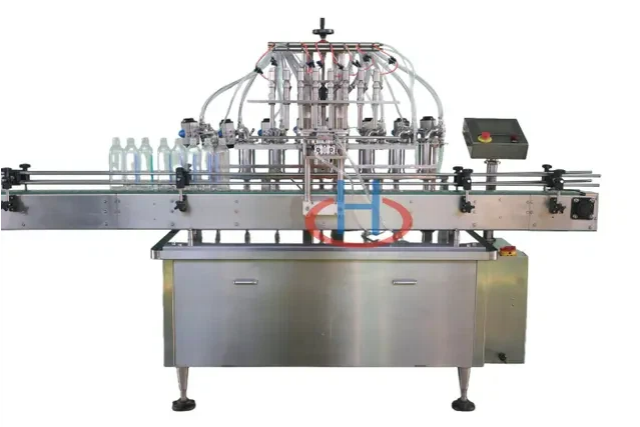
Use the checklist below to narrow choices.
Viscosity: low → gravity or pump; medium-high → piston or pump.
Foaming tendency: high → bottom-up, isobaric, slow fill.
Particles/solids: present → pump or piston (avoid small-orifice nozzles).
Container type: glass → level/overflow; PET → timed or volumetric; cans → isobaric/pressure control.
Production speed: very high → multi-head volumetric or rotary fillers.
Sanitary requirements: pharma/sterile → SIP-capable, peristaltic/piston with CIP.
Example scenarios
Beverage bottling with carbonation: isobaric or pressure-filling to protect CO₂.
Viscous syrup: piston filling for controlled volume.
Cosmetic creams: volumetric piston or pump with gentle shear control.
Laboratory reagents: peristaltic filling for sterile, contact-isolated flow.
Drips — Anti-drip nozzles and timing sequences solve post-fill drips. Some nozzles retract below bottle necks after filling or use valve shutoff synchronized with piston stroke.
Foaming — Bottom-up filling, slower flow rates, and isobaric pressure control minimize foam. For sensitive products, adding an anti-foam agent or deaeration upstream helps.
Inaccurate fill — Regular calibration, wear-aware maintenance, and redundant flow measurement reduce drift. Servo-driven pumps maintain high repeatability compared to simple timed fills.
Cross-contamination — CIP/SIP, single-use tubing, and hygienic design eliminate cross-batch contamination.
Method | Best use | Pros | Cons |
Gravity | Water-like liquids | Simple, low cost | Less accurate at high speed |
Piston (volumetric) | Viscous products, high accuracy | High precision | More maintenance |
Pump-based / Peristaltic | Sterile lines, particulates | Clean, flexible | Tubing wear (peristaltic) |
Isobaric / Pressure | Carbonated drinks | Preserve carbonation | More complex, higher cost |
Overflow/Level | Visual consistency (glass) | Exact fill height | Waste for overfill tolerance |
Our Liquid Filling Machine is specialized for a wide range of liquid viscosities and production needs. Key features include precise volumetric and gravity filling options, advanced flow-control technology for smooth fills, anti-drip nozzle designs, adjustable speeds for small to high-volume lines, and CIP/SIP capability for strict sanitary control. All product-contact parts use FDA-approved stainless steel and food-grade seals to meet regulatory demands.
We offer modular configurations so buyers can choose piston heads, pump-based modules, or gravity stations depending on product needs. Integrated PLC/HMI with recipe memory makes changeovers fast and repeatable. For carbonated or foaming products, our isobaric modules and bottom-up nozzles reduce product loss and improve quality yield.
If you’d like detailed specifications or a performance quote, contact our sales team for a tailored evaluation and sample run.
Run a sample test: Always test with your actual product and container before committing to a machine model.
Consider total cost of ownership: Include spare parts (tubing, seals), maintenance labor, and downtime in purchase decisions.
Plan for expansion: Choose a machine platform that can scale heads or speed to match future output.
Sanitation plan: If your product requires frequent cleaning, prioritize robust CIP/SIP design and accessible diagnostics.
Automation integration: Confirm the filler integrates with cappers, labelers, and checkweighers for a full line solution.
Selecting the right liquid filling solution comes down to product properties, regulatory needs, and production targets. For low-viscosity, low-foam liquids, gravity or pump-based systems are economical and effective. For viscous, high-value, or tightly metered products, volumetric piston fillers deliver the precision you need. For carbonated beverages and delicate foaming products, isobaric and bottom-up systems protect product quality. Shanghai Haochao Machinery & Equipment Co., Ltd. designs machines that combine these methods with advanced flow control, anti-drip nozzles, and CIP/SIP features so you can maximize yield and maintain hygiene.
If you want a tailored recommendation or a demo, contact us for quoting, specification sheets, and sample testing of our liquid filling solutions.


